
Biblical Clarity on 'Judging Others - Matthew 7:1-5
Explore the teachings of Matthew 7:1-5 in this sermon that highlights the dangers of judging others. Discover how Jesus exemplifies compassion, truth, and self-examination, urging believers to reflect His character while standing for biblical truth against a critical spirit.
2/11/20266 min read


I remember several years ago in a small group and I am pretty sure that it was when Pastor Kevin was still here, but it could have been Pastor Ashley, any way during a small group time of sharing the ice breaker question was tell the group something that no one knows about you.
We went around the room and thought of things to share that most likely no one knew about. Then we got to Bob. Bob starts sharing about a time when he was about 15 and he and his parents got into an argument and Bob got mad and left. The Hendrix’s lived out on City Limit road in their underground house at the time. Bob walked to Highway 60 and started walking in toward Granby. About the time he made it to the Terry’s Auto Auction, a guy pulled over and asked if he wanted a ride. Being still mad Bob got into the car.
The guy asked, “Where are you headed?” “I am headed to Springfield”, Bob said. The guy replied, “Me too.” And as they drove through the countryside, they talked about life and what was going on with Bob and why he was headed to Springfield. Bob told him about the fight and he was just done. As they approach Monett, Bob starts to get uncomfortable with this man that is starting to ask a bunch of personal and inappropriate questions. Bob told the man to pull over so he could get out and he would not. In Monett, the light at 60 and 39 was red and Bob jumped out of the car and started running through the golf course, not realizing the man was right behind him.
Bob tripped and fell down and the man started pulling him back toward the car. The man started pulling Bob’s leg, just like Bob pulled everyone’s leg in the small group.
I figured it out about the time Bob said, “I started walking.” So, everyone was mad at me for not speaking up and letting them know that you couldn’t take Bob at face value.
Just because we see or hear something, doesn’t mean that we understand the whole story and we are quick sometimes to make judgements. We shouldn’t do that.
Let’s read Matthew 7:1-5.
That the whole “judge not” premise has been taken out of context and used against Christians because they do not understand what this means. Should we judge, absolutely not. Is speaking out against men, who say they are women, competing in women’s sports, changing in women’s locker rooms and using women’s restrooms judging, NO! They will say, “you can’t judge me”, that is not what that means.
Things that obviously go against the bible and against God and speaking out is not judgment. Is standing up against abortion judging? NO! Telling someone that they are going to Hell because they had an abortion is judging. Our responsibility is bringing light into a dark world. Jesus didn’t come to judge or condemn the world. Why do we do it? Because we make critical conclusions. Why do we make critical conclusions?
Point 1 tells us…
Critical conclusions come from a lack of compassion.
Matthew 7:1-2
Colossians 3:12-13
One of the great miracles of Jesus was when He fed the 4000. Yes, there was also a time the Jesus fed the 5000 and both are recorded in the book of Matthew. The story of the 5000 found in chapter 14 and the feeding of the 4000 is found in chapter 15. One of those times where God outsmarts His critics. Because if Matthew said 5000 and Mark said 4000, bible critics would say it was the same story and they got it wrong.
In the scriptures in the 15th Chapter of Matthew it says, “Jesus called his disciples to him and said, ‘I have compassion for these people; they have already been with me three days and have nothing to eat. I do not want to send them away hungry, or they may collapse on the way.”
33 His disciples answered, “Where could we get enough bread in this remote place to feed such a crowd?’”
Do you see it? Jesus had compassion. Jesus didn’t look at their situation and say, “Well, they have gotten themselves into this mess and they could have left and come back a few times.” He said, ““I have compassion for these people; they have already been with me three days and have nothing to eat.”
How about the woman caught in adultery that the religious leaders used as a prop for their plan to trap Jesus? Did they have compassion for the woman? Did they have compassion for Jesus?
What did Jesus do? Did He get come to critical conclusions about the teachers and Pharisees? Was He like, “Okay, I want you to list all your sins in front of everyone and we will see what punishment that you deserve for your sin.” Did He turn to the woman and say, “Well, you knew it was wrong when you did it and now you face the punishment”?
No! Jesus was like, “You know what, she did sin and if any of you are without sin, you may go ahead and get this punishment started.” And when all of those “justice seeking leaders” were gone, Jesus had more compassion and said, “I am not condemning you either, go and leave that life of sin.”
If you really want to stop coming to critical conclusions you need more compassion. Another reason we judge, point 2 tells us it is because…
Critical conclusions come from a critical character.
Matthew 7:3-5
Ephesians 4:29-32
Jack and Shane went duck hunting one Saturday. Jack always looked on the bright side of things and Shane, well he was one of those people the just sucked the life out of you, always finding something to complain or worry about.
Jack had just bought a hunting dog that he was quite proud of and waited with great anticipation of seeing how well the dog was trained. Shane on the other hand doubted they would see any ducks, or it would be too cold or someone would fall in the water, or….
It wasn’t but about 15 minutes after the guys got set up in the blind that some ducks flew over. Jack took a shot and one of the ducks fell into the water. Jack said, “I got one!” Shane was like you missed 5 of them. Jack smiled and said to the dog, “Go get it.”
The dog walked on top of the water to the duck and brought it back to the blind. About 45 seconds later, more ducks. This time Jack hit 2 with one shot and they fell into the water. “Woo who!” Jack yelled. “Go get ‘em.” The dog walked on the water and picked up one duck and flung it up on its nose and put the other in its mouth and carried them back to the blind with missing a beat.
Jack looked at Shane and said, “Have you noticed anything remarkable about my new dog?” Shane replied, “I did notice one thing. Your dog can’t swim.”
Way too often, we are too much like Shane than we are like Jack. Always seeing and pointing out the bad in things that we see or experience. Kind of like the Pharisees that tried to find the bad in Jesus actions, “Why does your teacher eat with such scum, tax collectors and sinners.”
We draw critical conclusions because we have a critical character, when we should take on the character of Jesus. Let me give you one more.
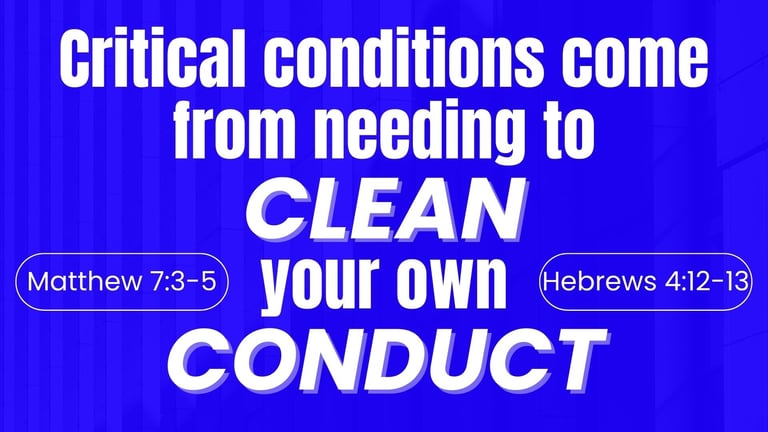
Critical conclusions come from needing to clean your own conduct.
Matthew 7:3-5
Hebrews 4:12-13
As a parent, a grandparent, a bus driver and a pastor, this is one that I would say that many of us have seen in others. Whether it is… Bus driver, Timothy hit me. “Timothy, why did you hit Tommy?” He hit me first. “Is that true Tommy?” Yes. Or Mark, you wouldn’t believe what Sister so and so did? “Don’t tell me that she was gossiping?”
Most of us experience this from time to time, but what we fail to realize is that many times we are the ones doing it. Just like Jesus said, “How can you think of saying to your friend, ‘Let me help you get rid of that speck in your eye,’ when you can’t see past the log in your own eye?”
For some reason, mainly pride, we like to point out the faults in others without even seeing the faults of our own. Sometimes we do it so we can look like the “saint” trying to help a brother or a sister. Sometimes we do it because if the focus is on someone else then it is not on us. What is really ironic, is something that I have talked about before, if Ronnie and I do the exact same sin, then my sin isn’t as bad as Ronnie’s. If we both steal a candy bar, it is because I was starving and Ronnie is a thief. He should be punished and I should be set free.
I love to watch crime shows, and one of the things that will be featured is the guilty person trying to get the police to look in another direction, to get them focused on someone else for the crime.
Even though you can fool me or anyone else and you think that you have gotten away with your sin, there is something you must understand “Nothing in all creation is hidden from God. Everything is naked and exposed before his eyes, and he is the one to whom we are accountable.” Today is the day to get rid of your judgmental attitude and to do that you must admit, that something is wrong with in you. How about getting rid of your critical character, clean up your conduct (live a holy life), and show more compassion?
Critical Conclusions


Welcome
Join us for weekly sermons and Bible studies.
Connect
Location
© 2024. All rights reserved.
Web design courtesy of Seven Social Marketing, LLC.
234 Cobb Hill Road
P.O. Box 243
Granby, MO 64844